





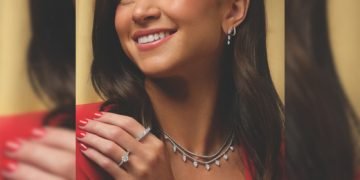


Key takeaways
• Visual presentation in fine dining can provide valuable staging lessons for selling high-quality jewelry.
• Effective store displays bypass the thinking brain and speak directly to a customer’s desires, helping to make their decision easy.
• Customizing product displays with specific thematic visuals acts as a subtle strategy to support the sales team and increase conversion rates.
Faculty at AJF member schools identified one outstanding graduating student from the current class. Below, you’ll see one work by each person. Click here to see more of the best work by these significant new makers.

Siri Hansen, Brooch 16
Siri Hansen was selected as the outstanding student from Konstfack University of Arts, Crafts and Design. Waste items are a starting point in her work. Instead of viewing them as products to throw away, she considers them valuable material that can—and should—be reused.
Hansen uses discarded plastics. The pieces are shaped with heat and pressure, using self-constructed tools alongside traditional jewelry and silversmithing techniques. She calls her process plasticsmithing. Balancing between adornment and critique, the pieces function as intimate yet political objects, inviting the viewer and wearer to reflect on what we choose to preserve, what we trash, and how these choices shape our relationship to the material world.

Larissa McPherson, Art Field Specimen in Habitat
Larissa McPherson was selected as the University of Georgia, Lamar Dodd School of Art’s outstanding student. Her work explores the accumulation of microplastics and waste in the environment, particularly within animals’ bodies.
Microplastics are now present in all living beings. In her work, McPherson envisions how this invasion might manifest visually in the bones animals leave behind. Plastic degrades and weaves its way through organic structures. Plastic film coats surfaces. Animal bone erodes, breaks down, and recedes in response to these intrusions. Using found plastics, bones, and 3-D printing technology, McPherson explores how the unique properties of the materials and process intertwine. Designed to reside on and interact with the human body, her jewelry serves as a tool to bridge the plastic invasion of nonhuman bodies with the parallel invasion occurring within humans.

Rune Vervoort, Verenkleed
Rune Vervoort was selected as the outstanding student from PXL-MAD School of Arts. Her visual language centers on repetition and variation. Though the actions are repeated, no two results are the same. These subtle differences give the work character and reflect Vervoort’s fascination with the balance between control and unpredictability.
The necklace shown above was made from wood pigeon feathers. By removing the recognizable form of a feather, Vervoort allows its details to come forward more strongly, guiding the viewer to see the material in a different way. Feathers serve as protection against weather conditions and external influences, but also as decoration and as a way of being seen. This duality strongly resonates with Vervoort. As a young designer, she often finds herself on the boundary between protecting and accepting herself.

Alice Kupri, Left to Be Forgotten
Alice Kupri was selected as the outstanding student from the Estonian Academy of Arts. She draws inspiration from everyday observations, ordinary objects, and playful or seemingly trivial subjects, which she translates into stone and metal.
The theme of her final collection revolved around the passage of time, memory, and forgetting. Inspired by the many parties she attended during her university years, she attempts to fossilize moments that are inherently temporary, unstable, and often forgotten. Above you see a life-sized phone carved from composite stone, with a stainless-steel screen and silver buttons, paired with life-sized wired earphones in cast silver-plated bronze; the keys in the background are cast in silver.

Ryan Seng, Noir Necklace and Limoges Porcelain Necklace 1
Ryan Seng was selected as the Cranbrook Academy of Art’s outstanding student. In addition to material exploration, he is interested in how utilitarian objects in our everyday lives function as ritualistic and intimate objects.
Before Cranbrook, Ryan worked as a menswear designer. “My closet mirrors my identity,” said Seng. “As a collection of memories, each garment carries the emotional residue from different life events.” Jewelry, he states, holds more of this power. He considers each piece of jewelry like a carefully crafted ensemble. The many materials must combine to create a beautiful visual while also eliciting a sense of tension and sensuality.


